
Monochrome LCD Displays: Custom Mono LCD Displays for OEMs
Engineered for industrial, medical, Instrumentation, Automation, Test and Measurement, Telecom, Transportation, Security, our monochrome LCD displays deliver the lowest total cost, the longest battery life, and the best sunlight readability of any LCD technology. Phoenix Display has produced custom mono LCD panels for over 20 years, in production runs from 5,000 to 200,000 units per year.20+ yrs
engineering custom monochrome displays
5,000–200,000
units/year typical production volumes
Used by
Schneider Electric, Honeywell, Clover, Iridium, GE Medical, Club Car
At a Glance
- Monochrome LCD displays provide lower cost, lower power consumption, and better sunlight readability than color LCDs.
- They are commonly used in industrial controls, medical devices, automotive systems, smart meters, and battery-powered equipment.
- Graphic, character, and segmented displays each serve different application requirements.
- Phoenix Display specializes in custom monochrome LCD solutions for OEMs’ products, ranging from 5,000 to 200,000 units annually.
Used by Industrial Leaders




What is a monochrome LCD display?
A monochrome LCD display is a liquid crystal screen that shows information in a single color, typically black, gray, green, or blue pixels on a contrasting background, instead of using full RGB color filters. Because mono LCDs skip the color filter layer and need less processing power, they cost less, draw less current, and last longer in extreme temperatures than color displays. They remain the standard choice for industrial controls, medical devices, automotive dashboards, point-of-sale terminals, smart meters, and battery-powered handhelds where information needs to be displayed clearly and reliably without the cost of full color.
When Is a Monochrome LCD Display the Right Choice?
A monochrome LCD display is typically the best choice when low power consumption, outdoor readability, long-term reliability, or cost efficiency are more important than full-color graphics. Many OEM products perform better and cost less when built around a monochrome display architecture.
01
When you don’t need full color If your product can communicate everything it needs to with text and simple graphics, a monochrome LCD panel will deliver the same information at roughly 30–60% lower display cost. If color won’t sell more units or raise your price, go mono.02
When the display lives outsideMonochrome LCD screens can be built as transflective panels, meaning they use ambient sunlight to brighten the image instead of fighting it. This makes them the most readable display technology outdoors, while drawing far less power than a color screen at maximum brightness. Ideal for marine equipment, agricultural controls, outdoor meters, and field instruments.03
When conditions get extreme Monochrome LCDs offer the widest viewing angles and the broadest operating temperature range of any LCD technology, typically −20 °C to +70 °C, with extended-range options down to −40 °C. They handle vibration, humidity, and thermal cycling better than color displays, which is why they dominate industrial and automotive deployments.Monochrome vs. Color LCD: How to Choose
| Factor | Monochrome LCD Display | Color TFT LCD Display |
|---|---|---|
| Unit cost | Lowest: typically 30–60% less | Higher: color filters add cost |
| Power draw | Very low, runs for months on a coin cell in some designs | High: backlight is the largest power consumer |
| Sunlight readability | Excellent: transflective options use ambient light | Limited: requires high-brightness backlight |
| Operating temperature | −20 °C to +70 °C standard, −40 °C extended | Typically -20 °C to +70 °C |
| Information density | Text and simple graphics | Rich graphics, photos, video |
| Processing requirement | Minimal: works with 8-bit microcontrollers | Significant: needs graphics controller/frame buffer |
| Best for | Industrial controls, medical, automotive, POS, meters | Consumer electronics, infotainment, GUIs, or any industrial application requiring full color content |
Types of Monochrome LCD Displays
Graphic Monochrome LCD Displays
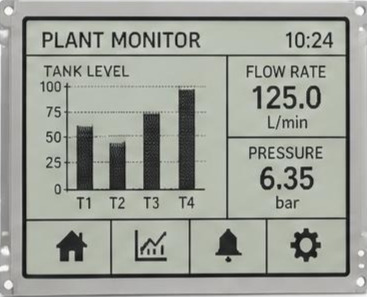
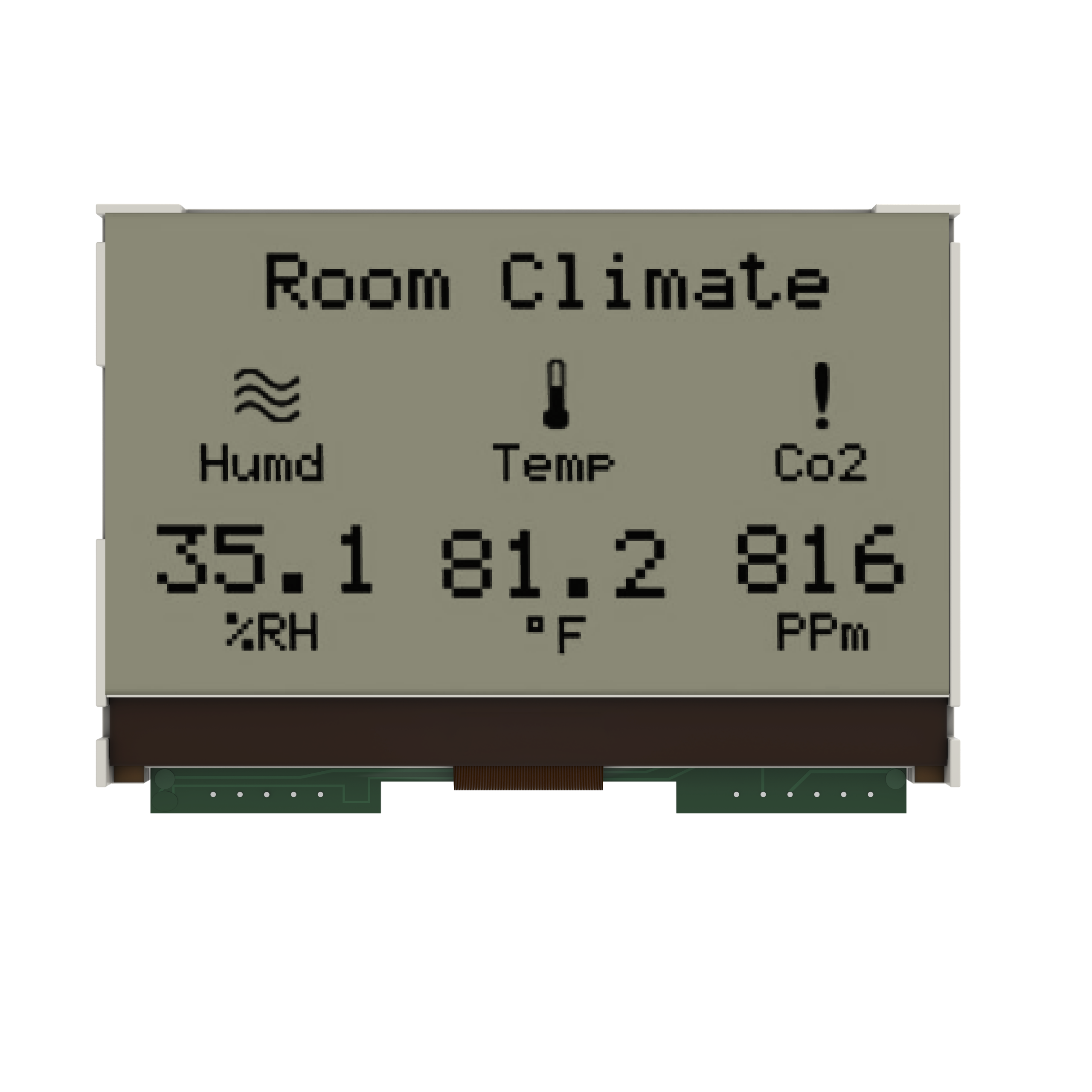
A graphic monochrome LCD panel uses a grid of individually controllable pixels, typically arranged in any resolution up to 320×240. Any pixel can be turned on or off, so you can show text in any font, simple graphics, icons, charts, and small UI elements anywhere on the screen. Best for: instrumentation, industrial HMIs, fitness equipment, and medical readouts.
Explore graphic mono LCDs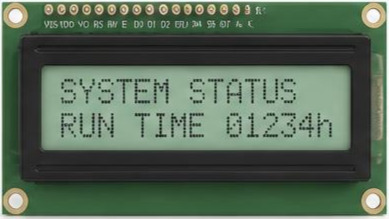
Character Monochrome LCD Displays
A character LCD is built around a fixed grid of character cells (e.g., 16×2, 20×4), each cell rendering a single letter, digit, or symbol. The driver chip handles font rendering, so even a basic 8-bit microcontroller can display text without any graphics work. Best for: cost-sensitive products that only need to show numbers and short text, coffee machines, vending, thermostats, and lab equipment.
Explore character monochrome displays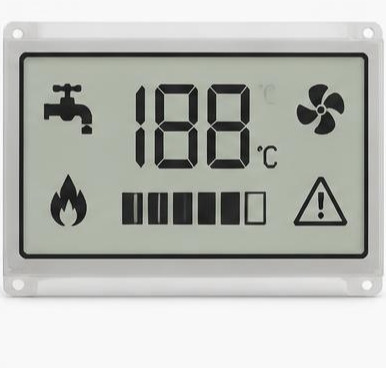
Icon (Segmented) Monochrome LCD Displays
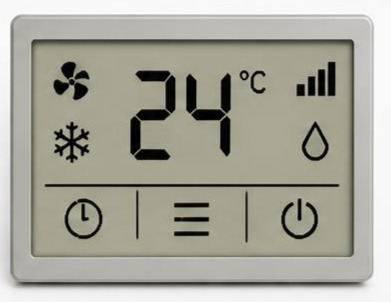
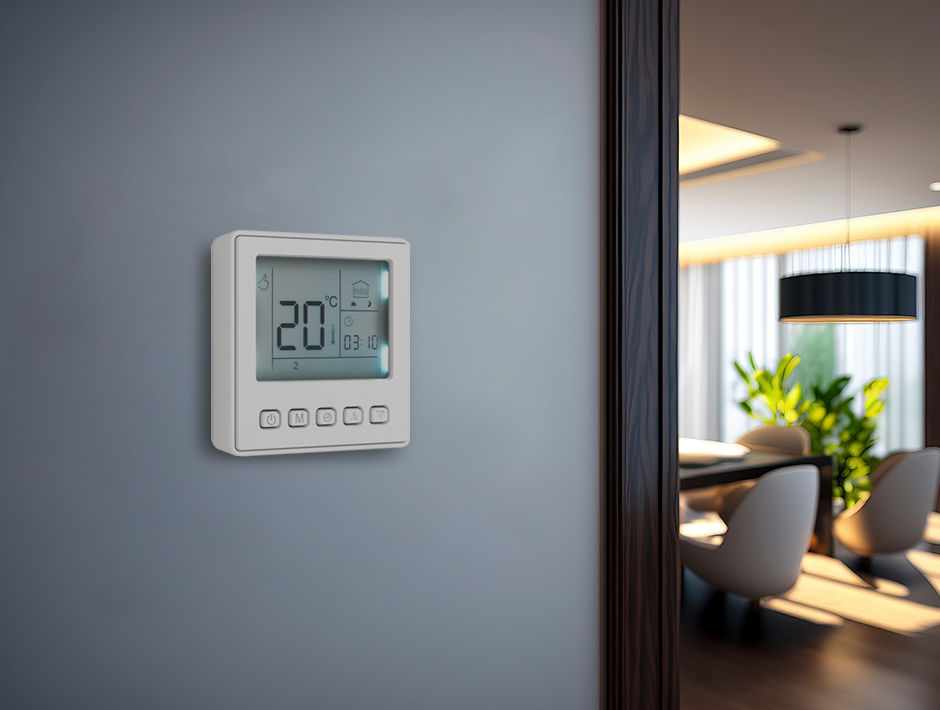
Instead of individual pixels, an icon mono LCD display uses fixed, custom-shaped segments, like the digits on a calculator or the icons on a smart thermostat. Each segment turns on or off independently. Because the shapes are hard-coded into the glass, icon displays draw almost no power and cost the least to produce in volume. Best for: applications requiring custom resolutions, controller integration, or specialized environmental performance, explore our custom LCD display solutions.
Talk to engineering about a custom icon displayLiquid Crystal Technologies Explained
Not all monochrome LCD panels are built the same. The type of liquid crystal used determines contrast, viewing angle, response time, and how well the display performs in cold or hot environments. Here’s how to choose:
TN: Twisted Nematic
The lowest-cost monochrome LCD technology, and the right answer when the display is simple. TN uses a 90° twist in the liquid crystal layer, which limits how many segments or pixels a single driver can address. It performs best on statically driven and low-multiplex designs, roughly 1:4 duty and below, where each segment is on close to 100% of the time and contrast stays sharp. Drive it harder than that and contrast drops, the viewing cone narrows, and the usable temperature range shrinks. TN also has the narrowest viewing angle of any passive monochrome technology, so it suits products read straight-on at close range. Best for: calculators, basic meters, appliance readouts, and icon displays with a small fixed segment count.
STN: Super Twisted Nematic
Once the content goes past what HTN can multiplex cleanly, typically several rows of dot-matrix data, STN is required to hold contrast and prevent ghosting. STN panels offer good contrast at very low power draw, which makes them the go-to for battery-powered devices and high-volume consumer products. Image color is typically blue, yellow-green, or gray.FSTN: Film-Compensated Super Twisted Nematic
STN with an added compensation film that improves contrast and gives the display a true black-and-white appearance. FSTN performs better in extreme temperatures and offers superior sunlight readability, making it the standard for outdoor and industrial monochrome screens. Many outdoor and industrial products that require enhanced readability also evaluate monochrome displays alongside color TFT displays during the specification process.
HTN: High Twisted Nematic
HTN increases the twist to roughly 110-130°, which buys better contrast and a wider viewing angle than TN for about 5% more cost. That extra twist also lets it hold contrast under moderate multiplexing, in the range where TN starts to wash out, so it covers character LCDs and multi-icon segment displays that TN can’t drive cleanly. HTN runs at low drive voltages, which is part of why it turns up in handhelds and battery-powered instruments. Best for: character LCDs, multi-icon segment displays, and any product that needs better off-axis readability than TN without the cost of STN.
Monochrome TFT (Thin-Film Transistor)
Most TFT panels are color, but for applications that need very high pixel density and fast response, like X-ray imaging monitors, ultrasound, and medical diagnostic equipment, we build monochrome TFT displays. They deliver the image quality of TFT with the focus and grayscale precision of a single-color screen.
| Technology | Best for | Contrast | Relative cost | Outdoor use |
|---|---|---|---|---|
| TN | Static and low-multiplex segment displays | Low (sharp at static drive, drops when multiplexed) | $ | Poor |
| HTN | Character LCDs and multi-icon segments needing wider viewing angles than TN | Moderate | $ (about 5% over TN) | Fair |
| STN | Battery devices, consumer, dot- matrix graphics | Good | $$ | Fair |
| FSTN | Industrial, outdoor, extreme temperature | Excellent (true black and white) | $$$ | Excellent |
| Mono TFT | Medical imaging, high pixel density | Highest | $$$$ | Good |
Not sure which monochrome LCD technology is right for your application?
Phoenix Display engineers help OEM teams evaluate viewing angle requirements, environmental conditions, power consumption targets, and manufacturing constraints to identify the most cost-effective display solution.
Talk to an EngineerChip Placement Options
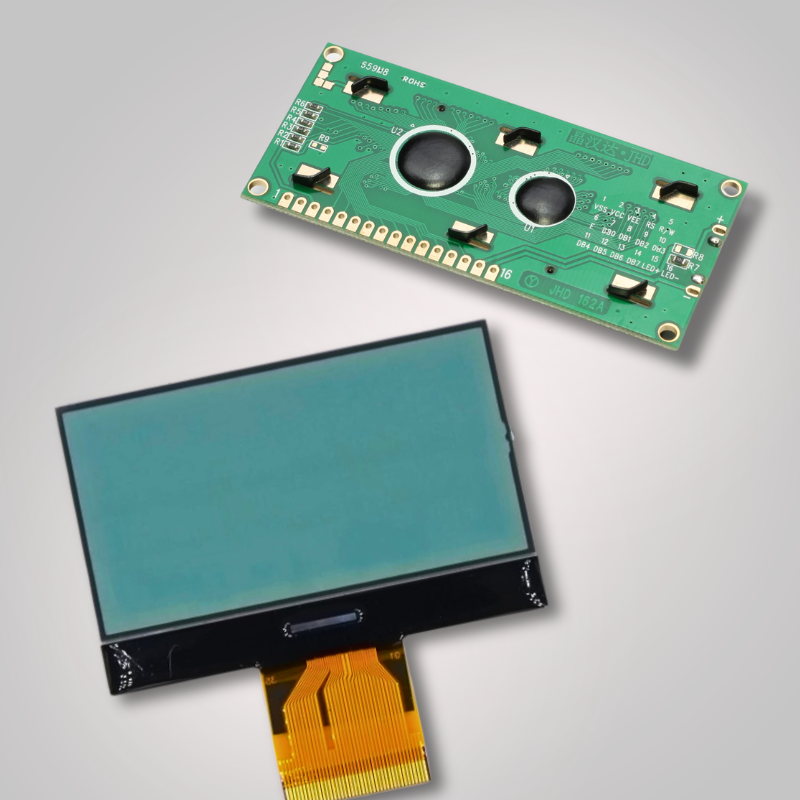
Every monochrome LCD module needs a driver chip, the controller that turns pixel data into screen output. Where that chip sits on the module affects size, cost, and reliability.
COB: Chip on Board
The driver chip is mounted directly onto the printed circuit board behind the display. This results in less wiring, fewer solder joints, and a smaller overall footprint, making COB the right choice when board space is tight.
COG: Chip on Glass
The driver chip is bonded directly to the back of the display glass itself. This eliminates the PCB layer between chip and pixels, giving the most compact, reliable, and lightweight monochrome LCD panel design, ideal for handhelds, wearables, and slim industrial products.
The Two Components That Define Display Performance
The LCD Panel
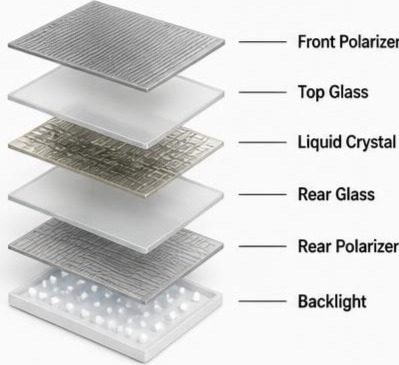
This is the heart of any monochrome display screen, a thin glass sandwich containing liquid crystal molecules that twist under voltage to control how light passes through. Three decisions define your panel: panel type (STN, FSTN, HTN, or mono TFT), resolution (pixel grid for graphic/character cells for character/segment count for icon), and physical size. Choose these based on your viewing distance, environment, and information density.
The Backlight
The LED backlight behind the panel determines how the monochrome screen looks in different lighting conditions. Three modes to choose from:
- Transmissive , backlight always on, best for indoor and low-light viewing.
- Reflective , no backlight, uses ambient light only. Lowest power draw.
- Transflective , a hybrid that uses ambient light in bright conditions and switches on the backlight in the dark. default for outdoor monochrome LCDs.
Common Applications
Phoenix Display monochrome LCD panels are used across a wide range of industries where reliability, low power consumption, sunlight readability, and long product life cycles are critical. Common applications include:
Where Phoenix Display monochrome LCD panels are deployed today:
Industrial controls and HMIs
PLCs, machine controllers, sensor readouts, process equipment
Medical devices
patient monitors, lab analyzers, portable diagnostic tools, dosing pumps
Automotive & marine
dashboard clusters, marine chartplotters, boat instrumentation
Point-of-sale and payment
card readers, POS terminals, kiosk displays, parking meters
Smart meters and utilities
electricity, gas, and water meters, building automation panels
Consumer appliances
thermostats, coffee machines, kitchen scales, fitness equipment
Test and measurement
oscilloscopes, multimeters, signal generators, calibration tools
Communications equipment
two-way radios, satellite terminals, networking gear
Mid-Volume Production: Our Sweet Spot
What production volume is best suited for a custom monochrome LCD? Most custom monochrome LCD programs become economically viable between 5,000 and 200,000 units annually, where OEMs benefit from customization without the pricing and support challenges common at very high volumes. Phoenix Display specializes in small-format, mid-volume monochrome LCD production, 5,000 to roughly 200,000 units per year. This is the volume range where the largest LCD manufacturers won’t bother with you, and the smallest shops can’t deliver consistent quality. We sit in the middle, which means:- You get a custom monochrome display engineered to your exact spec.
- Lead times and pricing stay predictable across the entire product life cycle.
- Units ship directly from our facility to your assembly line, in any country.
Two Paths to a Tailor-Made Mono LCD
These are our programs designed to provide you with the best LCD solution:
Get StartedNew Product Design
Designing a new product, or refreshing an existing one? Many engineers assume that a semi-custom or fully-custom monochrome LCD will cost more than an off-the-shelf panel. It doesn’t. A display engineered around your exact spec actually saves cost by removing pixels, segments, and features you don’t need, meaning you pay only for what your product actually uses.
Cross Match (drop-in replacement)
If you already use a monochrome display in production and you’re hitting one of the five common LCD problems, supplier quality issues, performance degradation, end-of-life/obsolescence, cost pressure, or delivery delays, our Cross Match program builds a drop-in exact replacement. Same form factor, same pinout, same behavior, so you skip the requalification.
Frequently Asked Questions
What is a monochrome LCD display?
A monochrome LCD display is a liquid crystal screen that shows information in a single color, usually black, gray, green, or blue pixels, instead of full RGB color. Because monochrome LCDs skip the color filter layer of the screen, they cost less to manufacture, draw less power, and operate reliably across a wider temperature range than color displays.
Are monochrome LCDs still used today?
Yes. Monochrome LCD displays remain the standard choice in industrial controls, medical devices, automotive dashboards, smart meters, point-of-sale terminals, and any product that runs on a battery or needs to be readable outdoors. Color screens have replaced mono in consumer electronics where rich graphics matter, but mono dominates anywhere reliability, cost, and power efficiency outweigh visual richness.
What's the difference between a monochrome LCD and a monochrome monitor?
“Monochrome monitor” historically referred to single-color CRT computer displays from the 1980s, the green, amber, or white screens used on early PCs. Today, a modern monochrome monitor is almost always an LCD-based monochrome display screen used in industrial, medical, or embedded equipment. The underlying technology is now liquid crystal, but the term “monochrome monitor” is still used in some industries to refer to single-color LCD readouts.
Which is better: a monochrome LCD or a color LCD?
Neither technology is universally better. Monochrome LCD displays are typically preferred when low power consumption, sunlight readability, and cost are the primary concerns. Color LCD displays are better suited for applications that require complex graphics, detailed user interfaces, or rich visual experiences.
How much power does a monochrome LCD use?
A reflective or transflective monochrome LCD panel can draw as little as a few microamps without a backlight, and 10–30 mA with the LED backlight on. By comparison, a color TFT of similar size typically draws 100–300 mA. This is why mono LCDs are the default choice for battery-powered handhelds, smart meters, and remote field equipment.
Can monochrome LCDs be read in direct sunlight?
Yes: transflective monochrome LCDs are specifically designed for outdoor and sunlight use. They reflect ambient light back through the panel, so the brighter the environment, the more readable the display becomes. Color displays struggle in direct sunlight because they rely entirely on the backlight fighting through the color filters.
What operating temperature range do monochrome LCDs support?
Standard monochrome LCD panels operate from −20 °C to +70 °C. Extended-temperature versions are available down to −40 °C and up to +85 °C, making them suitable for automotive, outdoor industrial, and military applications where color screens would fail.
Which monochrome display type should I choose: graphic, character, or icon?
Choose graphic if you need flexible layouts, text in different fonts, or simple graphics anywhere on screen. Choose character if your product only shows alphanumeric text and you want the lowest software complexity. Choose icon (segmented) if your product shows a fixed set of indicators, like a calculator, smart thermostat, or utility meter, and you want the lowest possible cost and power draw at volume.
What's the minimum order quantity for a custom monochrome LCD?
Phoenix Display specializes in mid-volume production: 5,000 units per year on the low end, up to approximately 200,000 units per year on the high end. Below that range, an off-the-shelf module is usually more economical. Above it, the largest LCD manufacturers become competitive on price. We’re built for the volumes in between.
How long does it take to develop a custom monochrome LCD?
Typically 6 to 8 weeks, expedited from 3. Engineering confirms tooling, qualification and delivery for your program.
20+ years engineering custom mono LCDs
Phoenix Display International, Inc. is a custom LCD manufacturer headquartered in Chandler, Arizona, USA. For more than 20 years, we have engineered and produced monochrome and color LCD displays for OEMs in industrial, medical, automotive, consumer, and commercial markets. Our customers include Schneider Electric, Bose, Verifone, PerfectPass, and Iridium. We specialize in mid-volume production, typically 5,000 to 200,000 units per year, and offer in-house engineering support, drop-in replacement (Cross Match) services, and full custom display design.
20+
years of LCD engineering experience200K
annual unit volume per customer (top end)5
named Fortune-tier customers−40°C
extended operating temperatureNot sure which monochrome LCD technology is right for your application?
Tell us about your application. Our engineering team will review your requirements, identify the right monochrome display technology, and send you a quote, usually within two business days. No obligation, no pressure.
Request a Custom Mono LCD QuoteCall (630) 359-5700 or Email sales@phoenixdisplay.com